
AnyMachine: An AI Agent Builds Working Machines in Blender
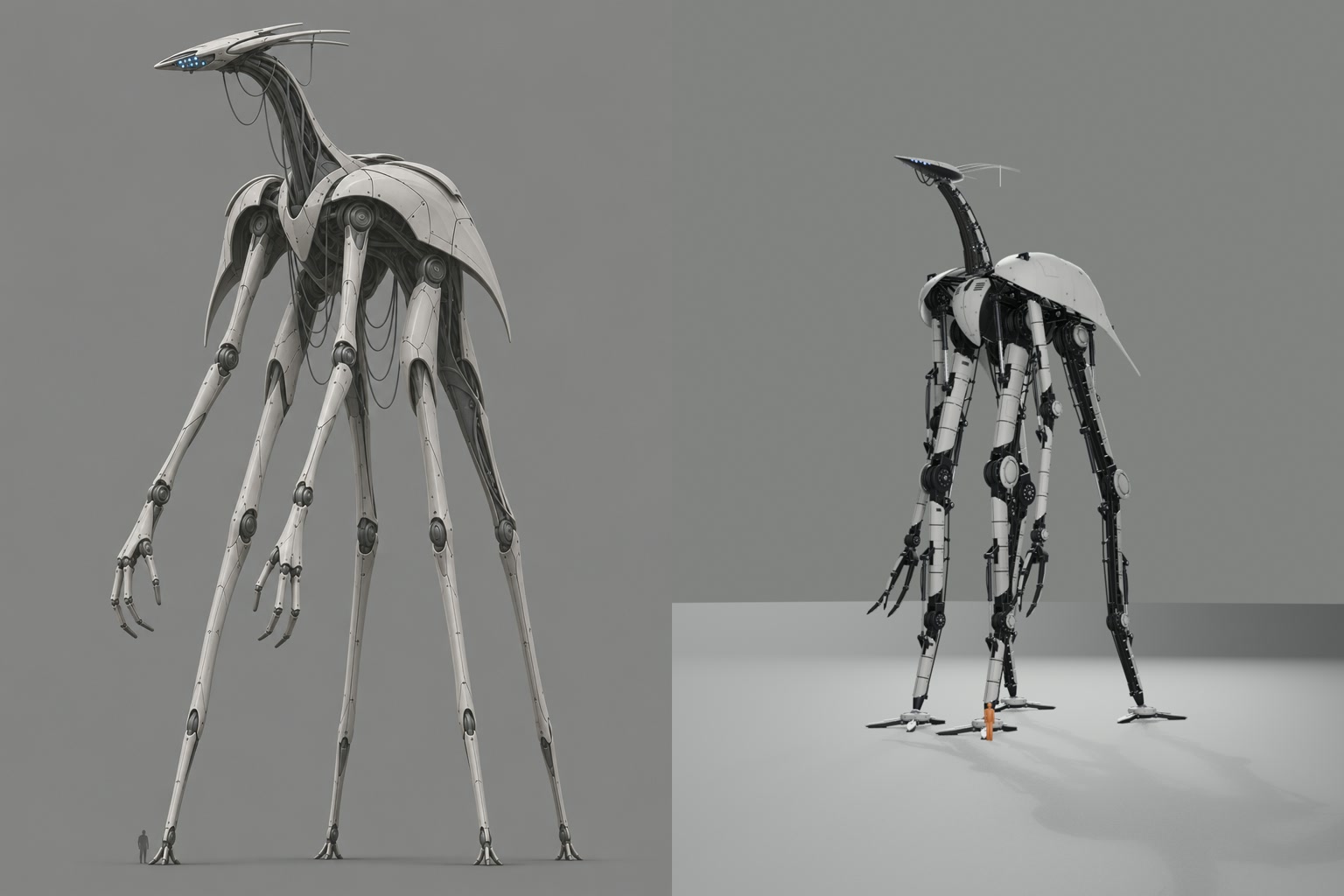
Image-to-3D generators give you a statue. The mesh looks right, but nothing moves, the parts are fused together, and a rig is your problem. AnyMachine by apekshik takes a different route. An AI agent (Claude Fable 5.2 running in Claude Code) writes Blender Python that builds the machine part by part, rigs it and animates it. A person picks the design and signs off on each stage.
The repo went up on November 4, 2026, is MIT licensed, and has over 700 stars. It's one of a set: AnyScene builds whole sets, AnyKit builds props, AnyShot shoots the result, and AnyMachine makes things that move.
Stilt: a 30 meter walker from one painting
The headline example is Stilt, a 30 m four-legged walker. It started as one concept painting. The finished model has 160 parts, working hydraulics on every joint, a 104-bone rig and three animations: walk, reach and head turn.
Every part comes from one Python script. Run it headless in Blender 5.2 and it rebuilds the .blend and a .glb from nothing, texture bake included, in about 80 seconds.
The method, written up in the repo's PIPELINE.md:
- Turn the one concept image into a turnaround, single views and a close-up for every mechanism.
- Write a parts breakdown from those images.
- Write a script that builds the geometry, materials, rig and animations.
- Render check images that put each reference beside the model, and fix what doesn't match.
The author's notes are honest about the result. Stilt has no intersections through all three animations, but it's plainer than its reference art in the hands, elbows and feet. You can see that in the comparison above: the body and legs match the painting closely, the hands are simpler.
Detailed props for games
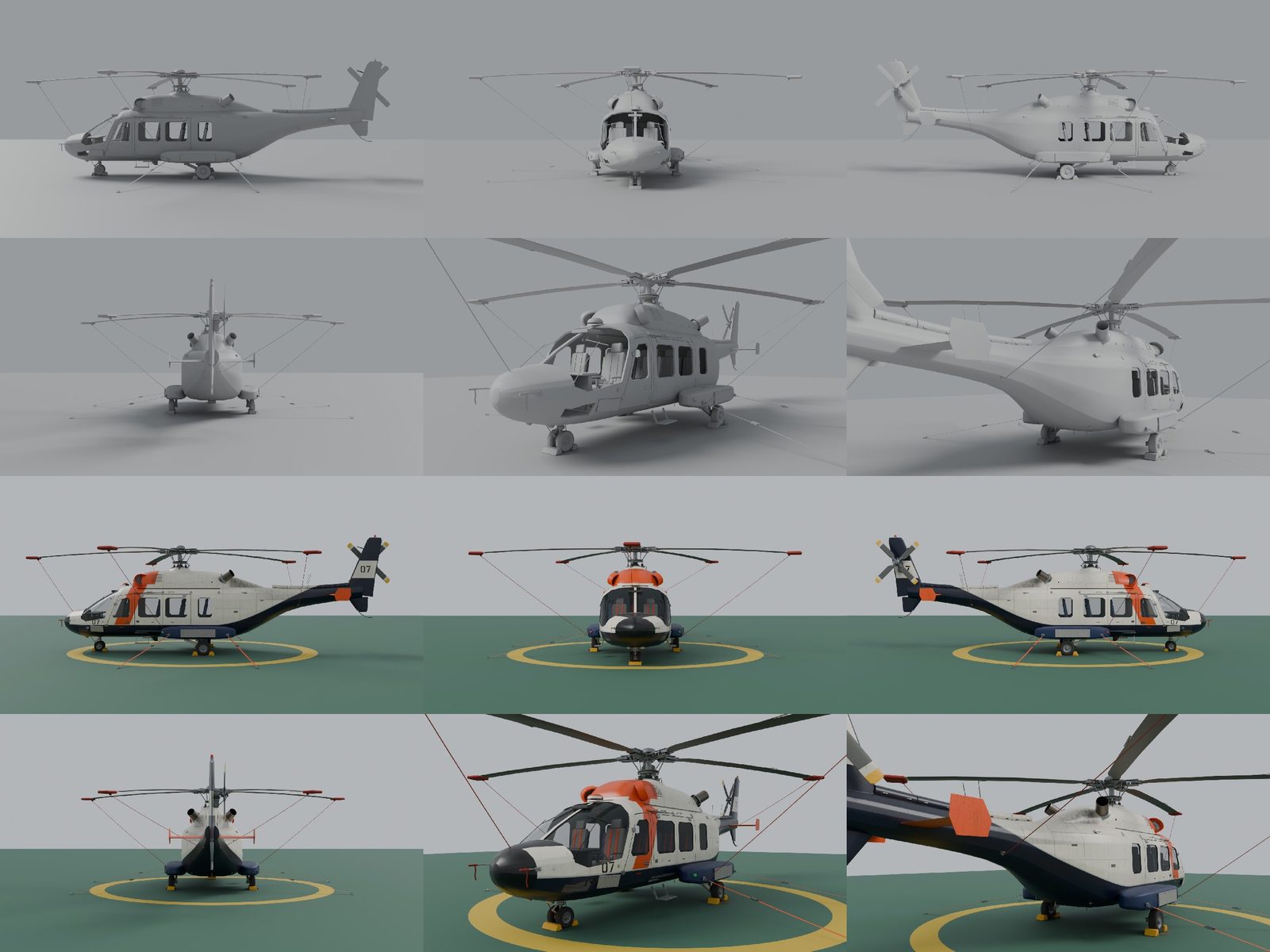
The newer work drops rigging and goes for detail. The agent built a helicopter with a full rotor head, cabin and cockpit (31,477 triangles, three texture sets), an enclosed lifeboat on its davit and winch, twelve pieces of oil-rig equipment, nineteen light fixtures and three rifles.
The steps: generate reference sheets of the object from six sides, then sheets of close-ups. Model it in Blender Python one real part at a time. Render it beside the sheets and do a second pass on whatever came out plainer. Bake textures and export game-ready. No image-to-3D meshes here. The lifeboat replaced one.
Again, the notes say where the models fall short: simpler and flatter than their sheets in places, and the helicopter hasn't been tested in a game yet.
Rigs from generated meshes
The third route starts with a mesh from a generator such as Meshy or Tripo and turns it into something that works:
- Treat the mesh as a skin. Measure where the joints are, then rebuild the moving parts as clean geometry on those axes, so nothing passes through anything.
- One slider per joint. Each control is a 0 to 1 value with limits, baked into glTF animations. In any engine you seek to a point in the animation and the object takes that pose.
- Check by machine. Sweep every slider for overlapping triangles, measure how far feet slip, and re-import the GLB to confirm it matches.
The results, from the repo's own table:
| Experiment | Result |
|---|---|
| Laptop (one lid hinge, 0 to 135 degrees) | Works. No overlaps over the full sweep. |
| Quadruped (trot, idle, sit, stand) | Works. 0.014 mm foot slip. Legs are plain slabs. |
| Spider (walk, idle, crouch) | Works. Generators gave 6 legs, the 8 came from the brief. Body is rough. |
| Backpacks (roll, clip, fill, flap, zip, straps) | Partly. The roll-top passes. The rucksack and daypack fail where controls interact. |
The backpacks are the interesting failure. Hinges and sliders cover hard objects, but a bag needs its own joint types for flaps, zips, straps and filling, plus a way to say which controls depend on each other. The notes draft those.
Why it matters if you make games
Most AI 3D tools stop at a static mesh. AnyMachine shows an agent can build props that open, walk and pass automated checks, from a script you can read and rerun. The checks are the key part: the agent proves there are no overlaps before a person ever looks.
It's labeled experiments, with no app or service to sign up for. To try it you need Blender and a willingness to read Python. The Stilt build runs with nothing but its script. Regenerating the reference art needs a fal.ai key.
Read the code and the notes on GitHub. If you put its props in a game, submit it here so players can rate it.
No comments yet. Start the conversation.
Sign in to comment